
On Jan. 2, 1990, engineers completed a 28-mile canal between the Chicago River and the Des Plaines River. The project reversed the flow of the Chicago River, causing it to run from Lake Michigan to the Mississippi River Basin. The effort is often given credit for Chicago’s massive growth in the 20th century, by directing sewage and other waste away from the young city’s drinking water supply.
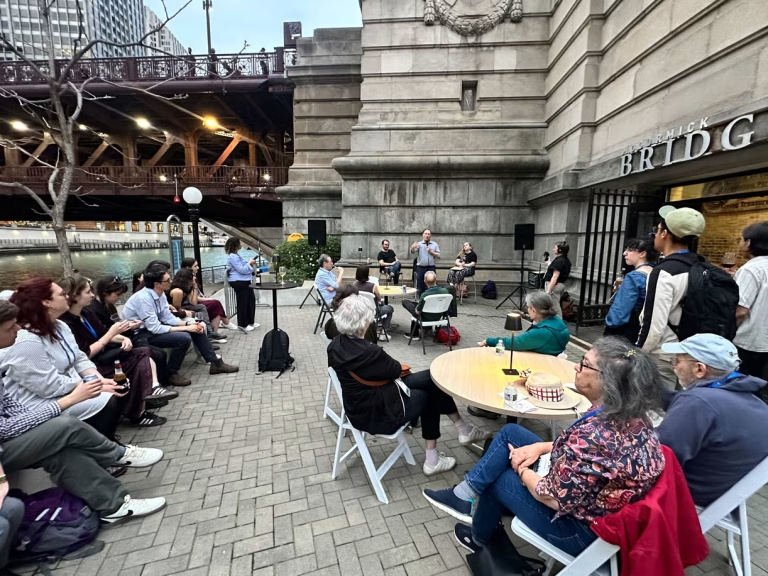
What happens when you reengineer the ecosystem so dramatically? The Ag & Water Desk recently explored that question in a conversation held at the McCormick Bridgehouse & Chicago River Museum during the Society of Environmental Journalists’ annual convention in Chicago. Madeline Heim of the Milwaukee Journal Sentinel interviewed Cameron Davis, a former adviser to President Obama who is now a commissioner with Chicago’s Metropolitan Water Reclamation District, and Nick Wesley, co-founder of the environmental nonprofit Urban Rivers, which has restored a portion of the Chicago River it calls the “Wild Mile.”Suffice it to say, this is a really important waterway,” Davis said, “and it’s important because of the scope of the combination of the two watersheds creating the mega-shed.”
What follows is an edited transcript of that conversation:
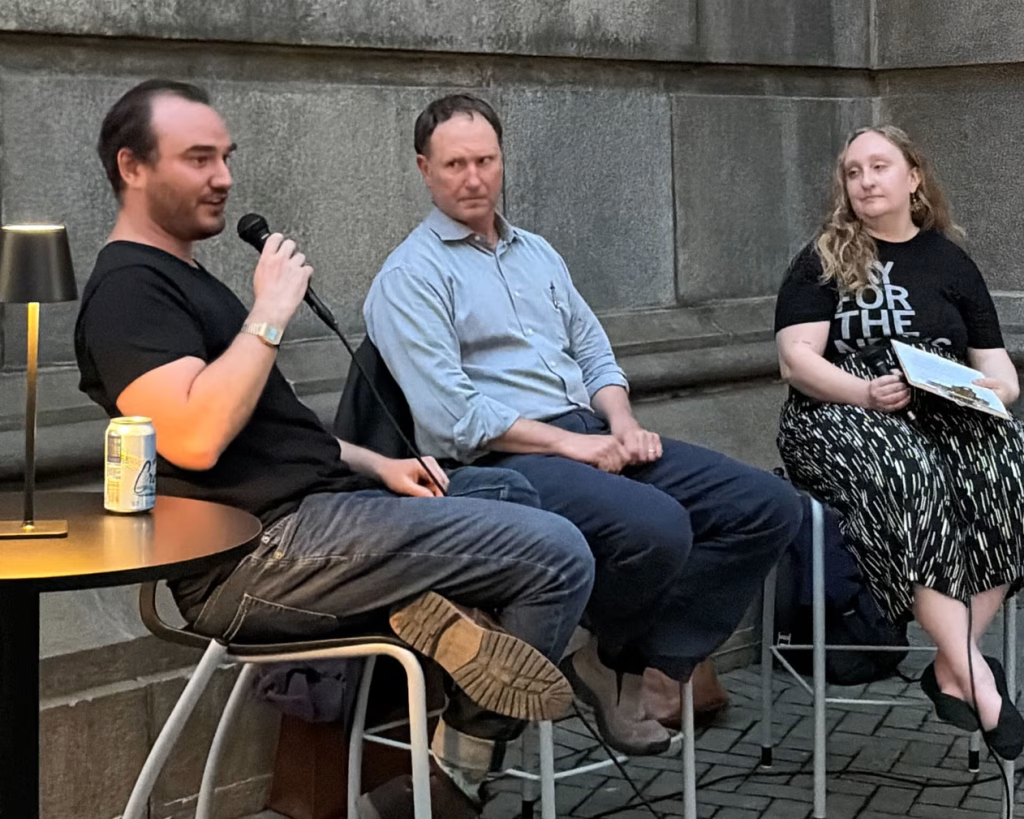
Madeline Heim of the Milwaukee Journal Sentinel moderates our panel with Cameron Davis (center), a commissioner with Chicago’s Metropolitan Water Reclamation District, and Nick Wesley (left), co-founder of the environmental nonprofit Urban Rivers. (Dominique Hodge/Ag & Water Desk)
Madeline Heim: I’m wondering if you could talk about the environmental impacts of such a decision on the ecosystem as a whole. What effects do we still see today?
Nick Wesley: If you look through any urbanized river system — any city that’s industrialized between 1850 and 1950 — you’ll see a lot of the exact same problems. You’ll see the systems copying each other. So you’ll see concrete walls or steel sheet piles, the rivers have been dredged, dammed, straightened, any bend or meander has been engineered out of it.
The big reason for that is shipping. We wanted to move things back and forth and the river was one of the primary transportation hubs, other than rail, back in the day. But as you know, we changed our mode of transport, we started building highways. And it decoupled a lot of the industrial traffic from the actual waterways. So in a lot of areas we don’t have a lot of these goods going through, we’re left with this industrial corridor.
So in my opinion, the best thing you could do is tear down the seawalls, make it meander, make it flood, make it do all of the things that it used to, all the ecological functions that it used to have. But in an urban environment, it’s just not really possible. You have stuff like this you can’t really dig through and knock it down, as many might like to. Well, what do you do in those areas?
And so our approach was to build these modular floating wetlands and floating parks along the river edge. And so these things, they try to emulate a lot of the processes that you find in a naturalized river ecosystem. One of the main features is a bunch of floating gardens where the plants, they’re all native plants that you’d find on a river edge and the roots grow through the units, they hang down below, which creates structure and habitat for fish and other wildlife. A lot of microbes grow on those things.
We add in other habitat amenities such as mussel bunkers to bring in the native, freshwater mussels that were basically ubiquitous throughout these river systems. And just piece by piece try to reconstruct a lot of the things that you would find. And then what that results in is both a place where you’ll see an abundance of diversity of different wildlife.
So by the Wild Mile, you’ll see beavers. We just saw the first snapping turtles coming back after their brumation or hibernation period. You’ll see tons of birds. I think we’ve had 112 bird species spotted at the Wild Mile.
Which is cool on its own, but the thing that I think makes it really interesting is it’s connected to the community around it. So people who’ve lived here for quite some time — or just who are in the area — can actually go down and enjoy all this stuff, see it in person within the confines of a city like this. So we’ll have people who are looking for the beavers, looking for muskrats, looking at the coyotes that come through — all this stuff that they didn’t really realize could live in a city and they’re able to actually then enjoy it and have it part of their daily routine.
The ecological context of reversing the river, I mean, it was dynamite. It changed the complete topography of the whole region. These were very separate ecosystems.
I mentioned the mussels. We all know about the Zebra mussels, which have done just tremendous amounts of ecological damage. But in rivers like this, the native mussels in some cases made up 90-something percent of the biomass of the system. And in the process of transforming our whole river for the use of moving sewage out of the city and moving boats through, we dredged the river. So we physically removed all of these mussels that have a really tremendous effect on water clarity and other things like that, which then affects the aquatic plants that are through there.
It’s this domino effect of stuff that’s changed. And so part of our process is just trying to figure out what was a normal situation.
MH: One thing I really wanted to zoom in on that has been a focus of the Ag & Water Desk in the past is what happens when you connect a major metropolitan area and all of its nutrients that are coming into the water with something like the Mississippi River, which already has issues with lots of phosphorus and nitrogen coming downstream.
We know that most of that is coming from agriculture, but as I understand it, the Chicago metro area is an extremely large single contributor to the water flow of the Mississippi River. And so, Cam, I’m wondering if you could talk a little bit about how MWRD has tried to limit some of those nutrients that are coming downstream.
Cameron Davis: One of the things that I need to mention in that context is that when the reversal of the Chicago River happened, it created what we call the Chicago River Diversion. And this is another element to the story that sometimes gets told, sometimes it doesn’t. When that happened, Canada got very upset with us because the United States was removing water that should be shared with Canada. There was a lawsuit. Some of the other states got upset with Illinois about the reversal as well because the diversion, as it came to be called, was removing water from Lake Michigan from their states too.
Think about Michigan. It’s Michigan’s water too. So there was a lawsuit that ultimately went to the U.S. Supreme Court. It ended in a consent decree in the early 1960s and to this day, this is the longest-running consent decree in U.S. history still under U.S. Supreme Court supervision.
Now, this is important because what goes into this river system then flows downstream and as you heard, we can get what’s called hypoxia, dead zones, areas that are depleted of oxygen because of nutrients, particularly phosphorus but also nitrogen in these areas. And agriculture is the number one contributor of that. If you think about states that line the Mississippi River basin, a lot of them — most of them, probably even all of them — are very concentrated with agricultural land uses. So, should not come as a surprise that nutrient-based fertilizer will run off those farm fields into the Mississippi River basin and ultimately down to the Gulf.
One of the things that the agency [MWRD] has done is install phosphorus removal technology that essentially removes the phosphorus from the waste stream and turns it into a usable product. That installation is the largest nutrient removal project in a water reclamation plant anywhere in the world.
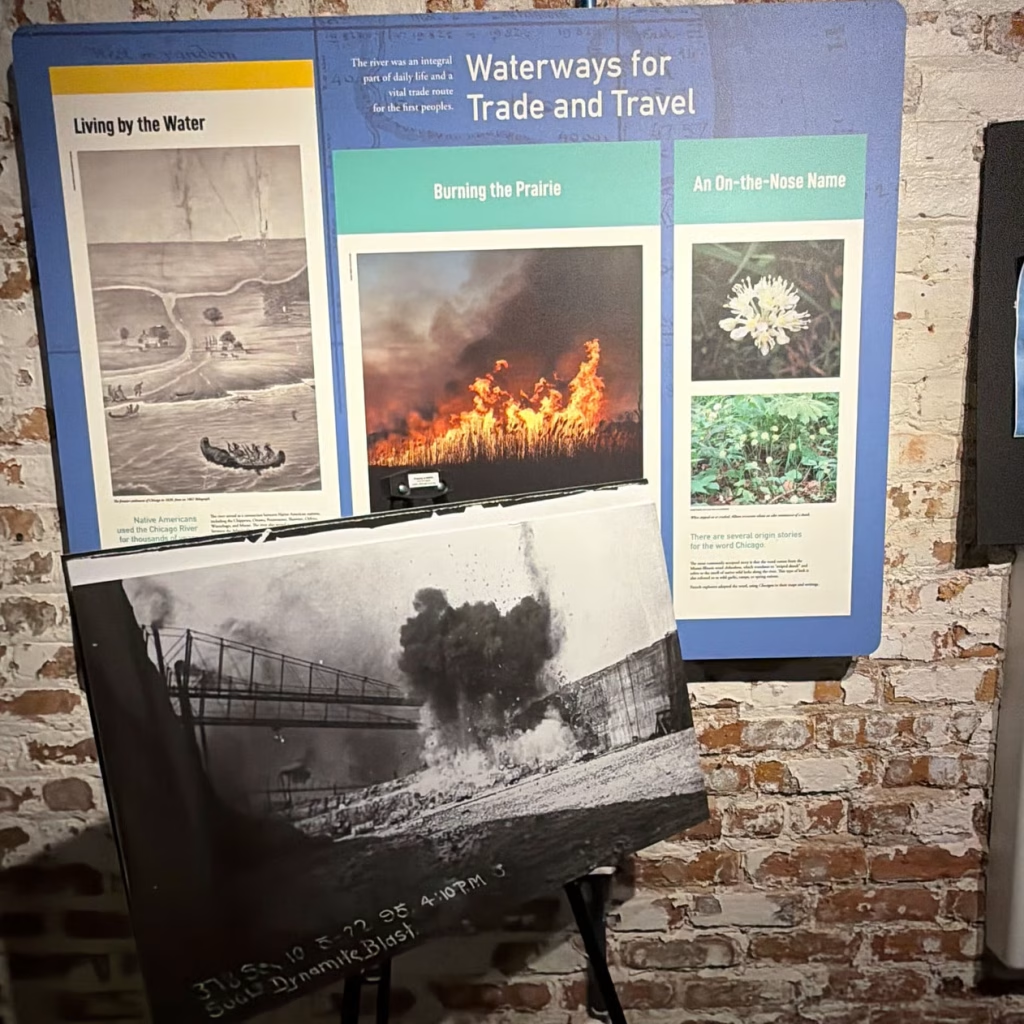
A photo display inside the McCormick Bridgehouse & Chicago River Museum explains the river’s impact. (Dominique Hodge/Ag & Water Desk)
MH: Nick, you talked about the Wild Mile and I love hearing about how it’s brought people back to the Chicago River in a way that maybe for a long time was not possible. I’m wondering if you could also talk about Urban Rivers’ work in Bubbly Creek.
And first, can you tell us why it’s called Bubbly Creek?
NW: Yeah, so Bubbly Creek is the one of the most notoriously polluted areas I think of any river in some ways. Upton Sinclair wrote about it in The Jungle about how it was essentially the dumping ground for all these carcasses and stuff like that, and as they rotted they would release methane, whatever gases, as they were decomposing and then it would create this bubbling cesspool of dead cows and stuff like that. And it’s got a low flow, too.
So it’s had a history. It has a very toxic legacy. And one of the things we’ve done is we started installing [with assistance from Chicago’s Shedd Aquarium] these floating gardens down there. So we have an archipelago of these floating islands all with native plants doing the same thing as the Wild Mile, with the roots going down pulling up excess nutrients, creating habitat for pollinators, other things like that.
I think one of the interesting points is for the communities around it, they’re so used to this being this no-go zone, this place that everyone assumes is just awful. And having these floating gardens there and seeing the wildlife coming back, it really is showing people that this isn’t what it always has been. It has a lot more potential, it’s a lot cleaner than it used to be, and it really is a key place in the ecological context of the Chicago River.
Every Friday we have this free community kayak program where anybody can come out, get in a kayak, tour the gardens, hang out. They have fishing and other activities there at the same time. So it really starts to bring people back to the river and see it as this asset that it really is — something that people should be happy to live near, rather than the legacy of the stockyards as it previously was.
MH: Do you think they’d ever rename Bubbly Creek?
NW: I love the name. I think they should keep it. I think is important because it shows that even the worst areas can be progressed into something better.
CD: I want to add on to what Nick just said. Bubbly Creek is still very contaminated. We’re still living with the legacy of contamination that wound up in the Chicago River, settled at the bottom in the bottom sediments of the river system, and we still have in this 156-mile stretch of Chicago-area waterway system a lot of legacy contaminant in that sediment.
Sediment is like soil. You wouldn’t want to grow your food in contaminated soil. Likewise we don’t want fish growing from contaminated sediment.
So right now, I think we’re on the cusp of reversing 100 years of that toxic legacy with the U.S. EPA and the Corps of Engineers leading the charge on mapping where that contamination is and then ultimately addressing it in one way or another in pockets around the river system, like Bubbly Creek.
This is unbelievable. It is something that many of us have been working for and fighting for for generations, and the notion that this wheel could be starting to turn right now is I think one of the most important things that this region can be doing at this moment to help with local economic revitalization, public health and … the list goes on and on.
MH: As you mentioned, there was a lot of anger from downstream cities, from Canada, from other states. And I’m wondering what you think Chicago owes to downstream communities today given that change, and what more do you think could be done, given that all of this water is heading down there?
CD: I’m not sure that there is a very short way to answer that question. But there have been a lot of studies that have been done to show that the water quality that starts here is very different than water quality that exists downstream. The advancements that have been made in sewage treatment, wastewater treatment, have been enormous over the past several decades.
The great irony of the reversal of the Chicago River is that within about 30 years, water treatment advancements had been made to the point that it obviated the need for the reversal of the Chicago River from a water quality standpoint. I don’t think this reversal is an engineering project would ever be done again.
Audience: Louisiana also has a massive Mississippi River engineering project in the form of the Old River Control Structure. We engineered the bottom of the Mississippi River to follow the route it follows now, but it wants to move. It wants to follow the Atchafalaya River basin. So I wondered if there are any natural pressures here that are trying to revert the Chicago River back to its original direction?
NW: I mean, we did such an intense engineering effort in a lot of these areas that it’s very difficult to shift. But if you go to the West Fork of the Chicago River, there’s a lot more of a meandering area. You can see that topography change a little bit more.
I don’t know though. I don’t know if there’s anything other than small streams and offshoots and tributaries that are really pushed back. I mean, the Mississippi is so gigantic, and there’s so much force, and if you look at aerial maps over the years you see it always was moving.
I think one of the things our Chicago ancestors did was nip that in the bud.
CD: I think I agree with Nick. There are unnatural pressures. When we get a big downpour here, we have several fail-safes that the region uses in order to keep basements from flooding and all kinds of things like that. The very last resort is opening the locks at the end of this river and two other points in the river system.
In 2023, we had something happen that had never happened before in the history of this engineered system, and that is we got such a downpour that we as a region could not use that last fail-safe of opening the locks to relieve pressure here in the river system
The lake was higher than the river system. So if MWRD had opened the locks, as it would have done under any other circumstance to relieve the pressure of rising water in the Chicago River, it actually would have sent water from the lake into the river and raised the river system even more.
So just an interesting factoid here about how weather is really forcing us to wrestle with how to adapt to a highly manipulated system like this one.
Audience: How did they do it? Reverse the river?
CD: It was reversed by connecting water systems. There was a lot of digging involved. There was a lot of dynamite blasting involved, because when engineers tried to join the river systems, there is a point in that area where all you have is just sheer limestone. So you couldn’t get shovels or backhoes or anything like that in. Dynamite had to be used to blast.
And one of the things that the Corps of Engineers did is make sure that connection continued to slope downward toward the Mississippi. So that gravity was ultimately what aided, what really created the flow that way.
CD: The agency was created in 1889, the last blast was in 1900, so it was, let’s say, about a decade it took, with all the planning and the actual work to be done. Work in earnest was shorter than that, but it was a big effort over a long period of time.
Audience: I’m curious about the relations with the other states because of the river reversal. How did St. Louis and the downstream states feel that basically Chicago was sending all their shit down there, and is it difficult to have inter-Midwestern relations because of that? Is that why the Cubs and Cardinals don’t like each other?
NW: Yeah, they didn’t like it.
CD: They really didn’t like it. What I will say is that, when the science showed that none of the effects of wastewater was reaching St. Louis — it really wasn’t even reaching Peoria — I think a lot of those concerns went away.
What’s interesting is in 1986 when so much of the Midwest was experiencing drought — might have been ’87 — many of the Midwestern states were calling for more water to be diverted out of the Great Lakes and into the Mississippi to help barge traffic. So, over time, sometimes you see the story changing to we want more water from Chicago to come down the Chicago River system. So really depends on what time frame you’re talking about.
Audience: Could you talk a little bit more about invasive carp and what’s being done to prevent them from getting into the Great Lakes and how that whole effort is going?
CD: Sure. So invasive carp. I’m going to tell you a quick story. My appointment to the Obama administration [as a senior advisor overseeing Great Lakes restoration efforts] came through in July of 2009, and I had not even officially started on the job when this new science of environmental DNA testing showed some hits of invasive carp DNA in the Chicago-area waterway system. And it presented a real dilemma to us: What did the DNA actually mean? Could it tell you where carp actually were? Did we know if carp got into the Great Lakes just how the scale of the destruction might be? The answer to all those questions was no, no, no, and no, we didn’t know.
Fast forward and when I was helping to coordinate the $2 billion Great Lakes Restoration Initiative fund. One of the biggest investments we made, and it still is today, was fighting invasive carp.
It’s been 10 years now. The federal government invested in electric barriers, in lots of other mechanical attempts to address the issue, approaches. But really the No. 1 thing that’s been effective has been funding the Illinois Department of Natural Resources to contract out to go and fish invasive carp out of the system.
What’s the best way to keep a species from establishing itself? Reduce the population of the species. And by your eating, Copi tonight, you are part of the solution. Yes, because that helps draw down the populations of invasive carp in the Illinois waterway.
Audience: As a Jewish person who just celebrated Passover and ate a lot of gefilte fish which has a lot of carp in it, I’m genuinely curious: Does anybody have relationships with Manischewitz or any of these industrial producers of gefilte fish which genuinely has been using carp for hundreds of years in the recipe?
CD: Wow. Does anybody have relationships? I can’t answer your question. I know I didn’t even know that until now.
NW: I just found out that gefilte fish has carp in it, so yeah. Sounds like a great idea. Someone should be doing it. Yeah. That’s it, yeah. Ground zero.