
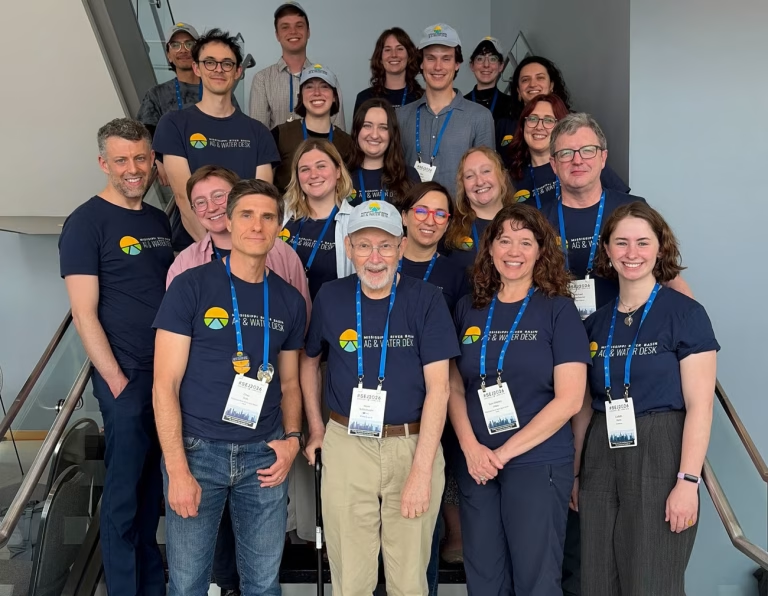
Every year, the Ag & Water Desk team gathers at the Society of Environmental Journalists’ annual conference for training, team-building and networking with hundreds of other attendees. Earlier this month, we brought 26 team members to Chicago for SEJ’s 35th annual conference, hosted by the University of Illinois Chicago. The Desk organized two major events: an all-day pre-conference workshop on Wednesday and a beat dinner on Friday.
We partnered with two great organizations to put on the workshop, “Using Data and a Solutions Lens to Enhance Your Environmental Reporting,” which drew about 100 participants. The Solutions Journalism Network led a morning session on applying a solutions lens to environmental problems, featuring our own Bennet Goldstein of Wisconsin Watch. The afternoon featured a hands-on data visualization training by Geoff McGhee of The Water Desk, our sister organization in the Colorado River Basin. We worked with a water system violation dataset prepared by our own data reporter, Jared Whalen. One journalism student said he now had the skills to make an interactive map of data centers. Another attendee brainstormed an idea for fresh coverage of seemingly intractable water pollution problems in Iowa.
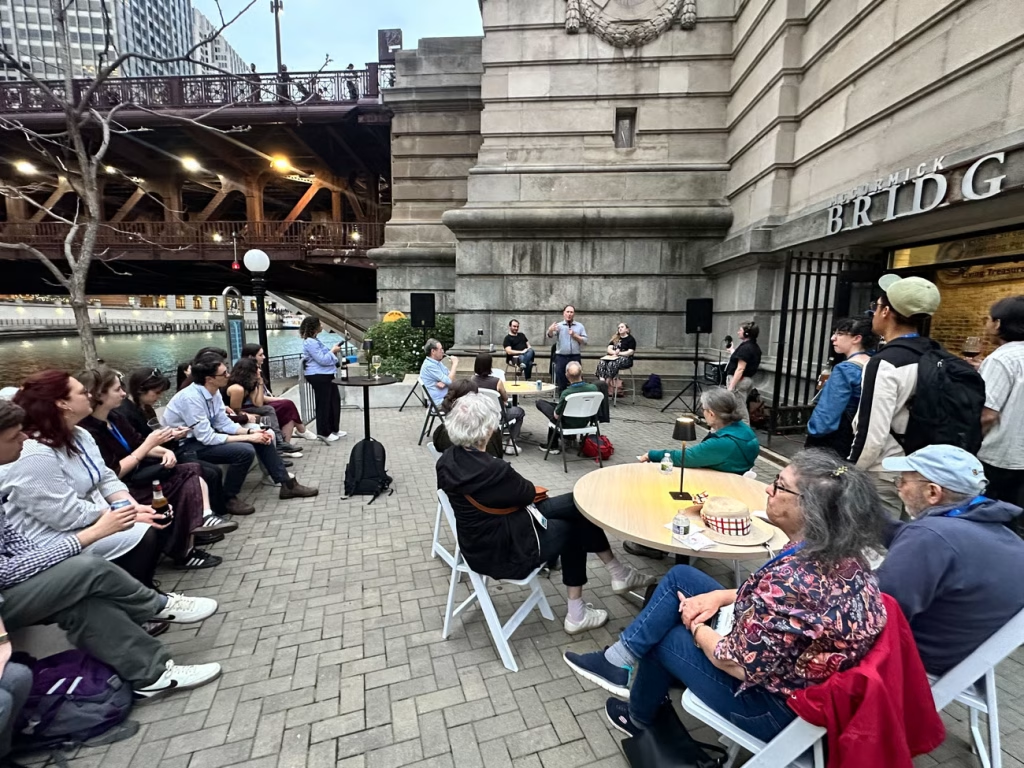
On Friday evening, the rain held off for our outdoor beat dinner, “The audacious engineering of the Chicago River and its consequences,” held at the historic McCormick Bridgehouse & Chicago River Museum on the downtown Riverwalk. Moderator Madeline Helm of the Milwaukee Journal Sentinel chatted with speakers Cameron Davis, commissioner of the Metropolitan Water Reclamation District of Greater Chicago, and Nick Wesley, executive director and co-founder of Urban Rivers, about the river’s past, present and future. We tasted fish cakes made of “copi,” another name for the invasive carp that have spread throughout the Mississippi River Basin, and climbed five levels of the bridge museum to learn more about river engineering.
Our team, which included reporters, expert journalists, staff, and four journalism students from the University of Missouri, also attended many other tours and sessions. Here are a few highlights:
Michael Hawthorne, Chicago Tribune: “SEJ conferences are opportunities to reconnect in person with old friends and make new friends. Those connections mean even more to me post-COVID. This year, an afternoon workshop hosted by the Ag & Water Desk introduced new methods to analyze water pollution data posted online by the U.S. EPA. I’m excited to jump into the work with more tools at my disposal.”
Julia Sklar, freelance: “My favorite part of SEJ was the Ag & Water Desk beat dinner. It was really useful to learn about the engineering of the Chicago River while standing next to it and touring the inside of one of the bridge houses. It’s easier to understand new information if it’s not just delivered in theory but alongside something observable. I also genuinely enjoyed eating invasive carp hors d’oeuvres — they were delicious!”
Kathleen Davis, Science Friday: “One of my favorite sessions was about reporting on the MAHA [Make America Healthy Again] movement in the scope of food and agriculture stories. We heard from two reporters who have done excellent, nuanced work. My big takeaway was that there’s a lot of room for local reporting, especially as state farm bills are discussed, on where the MAHA movement is breaking from Trump administration priorities and how that’s impacting legislation.”
Cassandra Stephenson, Tennessee Lookout: “On a ‘field trip’ to Jim Robbins’ soybean and corn farm near Peotone, Illinois, I got to see how one farming operation has transitioned to no-till practices and strip-tilling, allowing the farm to use less fertilizer and plant faster. Sitting in the tractor that controls planting, I saw the technology that makes precision strip-tilling and planting possible in Robbins’ corn field, and learned about options for farmers to offset the considerable cost of advanced equipment. This gave me ideas for questions to ask farmers in Tennessee, where soybeans and corn are also prominent row crops.”

I attended several sessions related to data centers. In one, we learned about “clean firm power,” and how data centers are accelerating the challenge of getting to 100% renewable power. Another session featured a panel of reporters covering the environmental footprint of data centers in the U.S. and Asia. It was interesting to hear how companies are using similar tactics, including non-disclosure agreements and jobs claims. These tips will be useful for the Desk and my own students as we report on this emerging story.
Attending SEJ is always educational and fun. As a remote team working across this widespread watershed, we cherish the chance to get together in person. And we get to share our collaborative spark with others. We need each other now, more than ever.
We’re looking forward to next year’s SEJ — our first international conference in Halifax, Nova Scotia!
Sara Shipley Hiles
Executive Director
Ag & Water Desk